Should you keep fulfillment in-house for control? Outsource to a 3PL for scalability? Or rely on dropshipping for speed to market? There’s no one-size-fits-all answer. The best model depends on your growth stage, margins, customer expectations, and long-term goals.
In this guide, we break down 3PL fulfillment, in-house fulfillment, and dropshipping; with real-world pros, cons, and use cases to help you choose the right strategy.
1. What Is In-House Fulfillment?
In-house fulfillment means you control the entire process: storing inventory, picking and packing orders, shipping, and handling returns; using your own warehouse, staff, and systems.
Pros of In-House Fulfillment
✔ Maximum Control You oversee packaging, branding, quality checks, and shipping workflows.
✔ Brand Customization Custom inserts, branded packaging, and tailored unboxing experiences are easier to execute.
✔ Potential Cost Savings at Small Scale For very low order volumes, fulfilling orders yourself may be cheaper than outsourcing.
Cons of In-House Fulfillment
✘ High Fixed Costs Warehousing, labor, software, equipment, and insurance add up quickly.
✘ Limited Scalability Handling seasonal spikes or flash sales can overwhelm internal teams.
✘ Operational Complexity Shipping rate negotiations, inventory accuracy, carrier management, and returns take time away from growth.
Best For
- Early-stage brands with low order volume
- Local or regional sellers
- Brands prioritizing hands-on control over speed
2. What Is Dropshipping?
Dropshipping allows brands to sell products without holding inventory. Orders are passed directly to suppliers who ship to the customer.
Pros of Dropshipping
✔ Low Upfront Investment No inventory purchases, warehousing, or fulfillment labor.
✔ Fast Market Entry Test products quickly without long-term commitments.
✔ Minimal Operational Overhead Ideal for validating ideas or launching niche stores.
Cons of Dropshipping
✘ Thin Margins Supplier costs, shipping fees, and platform competition compress profitability.
✘ Little Control Over Fulfillment Shipping delays, packaging quality, and errors are out of your hands.
✘ Longer Delivery Times Many dropship suppliers ship internationally, frustrating customers accustomed to fast delivery.
✘ Brand Risk Poor fulfillment experiences reflect on your brand—even if the supplier is at fault.
Best For
- New ecommerce entrepreneurs
- Product testing and MVP launches
- Businesses prioritizing speed over brand control
3. What Is 3PL Fulfillment?
A third-party logistics provider (3PL) stores your inventory and handles picking, packing, shipping, and returns on your behalf—using professional warehouses and technology.
At Simple Global, for example, brands leverage a global fulfillment network, advanced warehouse management systems, and ecommerce integrations to deliver fast, reliable orders worldwide.
Pros of 3PL Fulfillment
✔ Scalable Operations Handle sudden demand spikes without hiring or expanding facilities.
✔ Faster Shipping Inventory is positioned closer to customers, reducing transit times and costs.
✔ Lower Shipping Rates 3PLs negotiate bulk carrier discounts brands can’t access alone.
✔ Focus on Growth Free your team to focus on marketing, product development, and customer acquisition.
✔ Global Expansion Ready Easily ship cross-border with localized fulfillment and customs support.
Cons of 3PL Fulfillment
✘ Less Direct Control Requires trust and clear SLAs with your logistics partner.
✘ Variable Costs Fees are usage-based, which requires forecasting and margin planning.
✘ Onboarding Time Inventory transfers and system integrations require upfront setup.
Best For
- Growing DTC and B2B e-commerce brands
- Subscription businesses
- Brands selling internationally
- Businesses prioritizing speed, reliability, and scalability
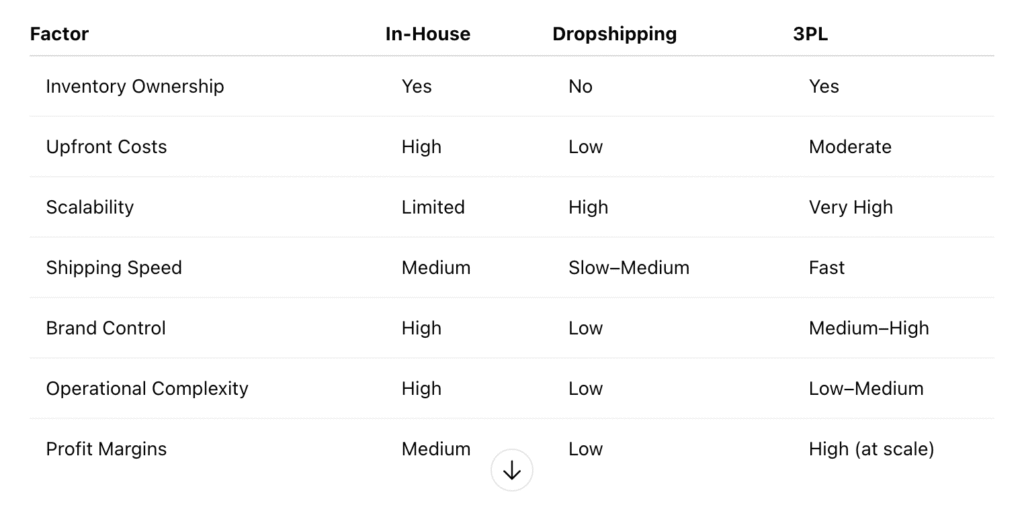
4. Side-by-Side Comparison
5. Which Fulfillment Model Is Right for You?
Ask yourself these questions:
- Are order volumes growing month over month?
- Do customers expect 2-day or next-day delivery?
- Are fulfillment tasks slowing down marketing or sales?
- Do you plan to expand into new regions or countries?
General rule of thumb:
- Dropshipping works for testing ideas.
- In-house fulfillment works for small, controlled operations.
- 3PL fulfillment works for scaling brands focused on customer experience and growth.
Many successful ecommerce brands start with dropshipping or in-house fulfillment and transition to a 3PL once volume, complexity, or international demand increases.
6. Why Brands Choose a 3PL Like Simple Global
Modern ecommerce requires more than shipping boxes. Brands need:
- Real-time inventory visibility
- Fast, affordable delivery worldwide
- Seamless platform integrations
- Reliable returns management
Simple Global helps ecommerce brands scale by offering:
- Global fulfillment locations
- Technology-driven warehouse operations
- Ecommerce and marketplace integrations
- Transparent pricing and analytics
The Next Step…
Global e-commerce is the norm, and customer expectations need to be met. Brands that invest in scalable, flexible fulfillment gain a powerful competitive advantage.
If your business is outgrowing in-house fulfillment or feeling the limitations of dropshipping, it may be time to explore a 3PL partnership built for growth. Learn more at Simple Global.