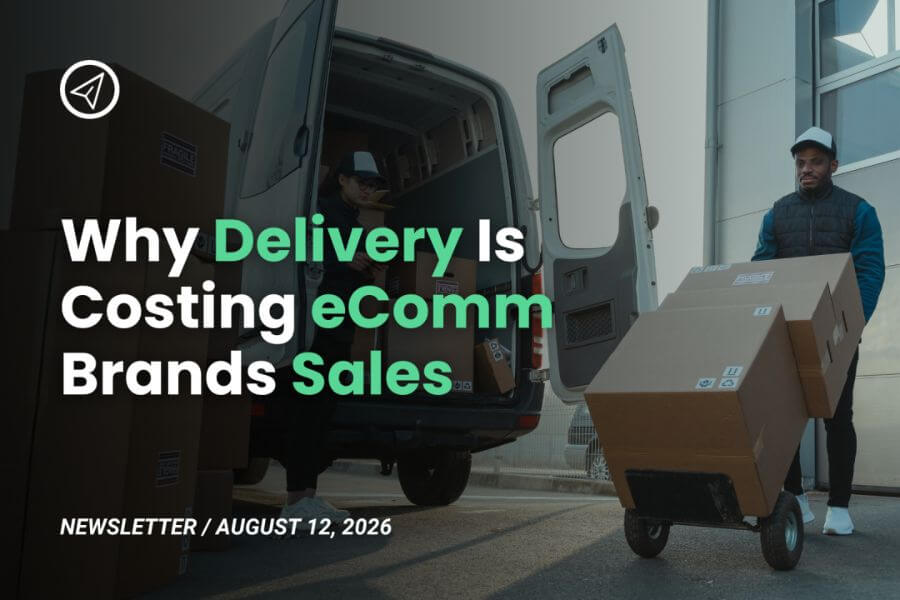

For many small and midsize ecommerce businesses, handling fulfillment in-house feels like the most economical option.
When order volumes are low, storing inventory, packing boxes, printing labels and managing carrier pickups yourself can make sense. But as a business grows, the same operation that once saved money can quietly become one of its biggest expenses.
And in 2026, those pressures are becoming harder to ignore.
FreightWaves recently highlighted how smaller shippers are facing rising costs from tariffs, fuel, last-mile delivery rates and changing carrier fees, often without dedicated logistics or trade-compliance teams to help manage them.
The problem isn’t simply that shipping costs more.
It’s that managing everything yourself creates costs that aren’t always visible on a carrier invoice.
The Hidden Cost of In-House Fulfillment
When ecommerce businesses calculate fulfillment expenses, they often focus primarily on postage.
But fulfillment involves far more than the shipping label.
Businesses also have to account for:
- Warehouse or storage space
- Packing materials
- Fulfillment employees
- Inventory management
- Warehouse equipment
- Software
- Carrier negotiations
- Returns processing
- Order errors and reshipments
- Customer support related to delivery issues
As order volume increases, these costs tend to increase with it.
A growing brand may suddenly find employees spending hours every day packing orders instead of working on marketing, product development or customer acquisition.
Eventually, fulfillment stops being a simple operational task and becomes an entire department.
Small Shippers Have Less Negotiating Power
Shipping volume matters.
Large logistics providers typically work with multiple carriers and move significantly greater parcel volumes than an individual ecommerce business.
That scale can provide greater flexibility when selecting carriers, service levels and shipping methods.
A small business handling a few hundred shipments each month may have relatively limited options. If a carrier introduces a new surcharge, raises a rate or changes its delivery terms, there may be little room to negotiate.
A fulfillment partner can instead evaluate shipments across multiple carriers and service levels depending on destination, cost and delivery requirements.
The goal isn’t simply to find the cheapest label.
It’s to find the most efficient way to deliver each order.
Growth Makes Fulfillment More Complicated
The challenge becomes even greater when a business begins selling through multiple channels.
A brand might start with Shopify before expanding to Amazon, Walmart, eBay, wholesale customers or international markets.
Suddenly, inventory has to remain synchronized across multiple platforms.
Orders need to be routed correctly.
Marketplace requirements have to be followed.
Returns need to be processed.
And customers still expect their products to arrive quickly.
What worked for 20 orders per day may become extremely difficult at 200 or 2,000.
This is where fulfillment infrastructure becomes important.
Modern 3PL operations can connect ecommerce platforms, marketplaces, inventory and shipping within a centralized system, reducing many of the manual processes that become increasingly difficult to manage at scale.
Warehouse Location Matters Too
Shipping cost isn’t determined only by the carrier.
Where your inventory is stored can have a major impact on both price and delivery speed.
If every order ships from one warehouse on one side of the country, products traveling to customers thousands of miles away generally spend longer in transit and may cost more to deliver.
A distributed fulfillment strategy allows businesses to position inventory closer to major customer markets.
Simple Global, for example, operates a network of fulfillment locations designed to help ecommerce businesses strategically position inventory while supporting domestic and international distribution. Its fulfillment services include inventory management, multi-channel ecommerce fulfillment, global shipping, returns management and warehouse technology.
For growing brands, this provides an alternative to leasing and operating additional warehouses themselves.
Then Comes Peak Season
In-house fulfillment can appear manageable for most of the year.
Then Black Friday arrives.
Order volume spikes, warehouse teams become overwhelmed, carrier networks tighten and customers expect packages to arrive faster than ever.
Businesses managing their own fulfillment face a difficult choice: maintain enough staff and warehouse capacity for their busiest weeks — even if much of that capacity isn’t needed during slower periods — or risk struggling when demand suddenly increases.
Outsourced fulfillment allows businesses to build more flexibility into their logistics operation.
Instead of continuously expanding internal infrastructure every time order volume increases, businesses can use a fulfillment network designed to handle changing volumes.
When Does Outsourcing Fulfillment Make Sense?
There isn’t one specific order volume where every company should switch to a 3PL.
For some businesses, fulfilling orders internally may continue to make sense.
But there are several warning signs that the operation may be reaching its limits:
Shipping is consuming more employee time.
Warehouse space is running out.
Orders are frequently delayed.
Shipping costs are becoming difficult to control.
Inventory is becoming harder to track.
The business is expanding into new marketplaces or countries.
Peak-season demand is becoming increasingly difficult to manage.
At that point, the question shouldn’t simply be:
“How much does a 3PL cost?”
Businesses should also ask:
“How much is our current fulfillment operation actually costing us?”
That calculation should include labor, storage, technology, packaging, carrier costs, errors and — perhaps most importantly — the time being taken away from growing the business.
Logistics Should Support Growth, Not Limit It
Handling fulfillment yourself can be an excellent way to get an ecommerce business started.
But the logistics model that helps a company reach its first 1,000 customers isn’t necessarily the model that will help it reach the next 100,000.
As order volume grows, logistics becomes increasingly complex.
The right fulfillment strategy allows businesses to scale without having to build an entire logistics network themselves.
Simple Global helps ecommerce businesses manage warehousing, inventory, order fulfillment, shipping and returns through a global 3PL network — allowing brands to spend less time managing boxes and more time growing their business.
Ready to see whether outsourced fulfillment makes sense for your business? Explore Simple Global’s ecommerce fulfillment solutions.