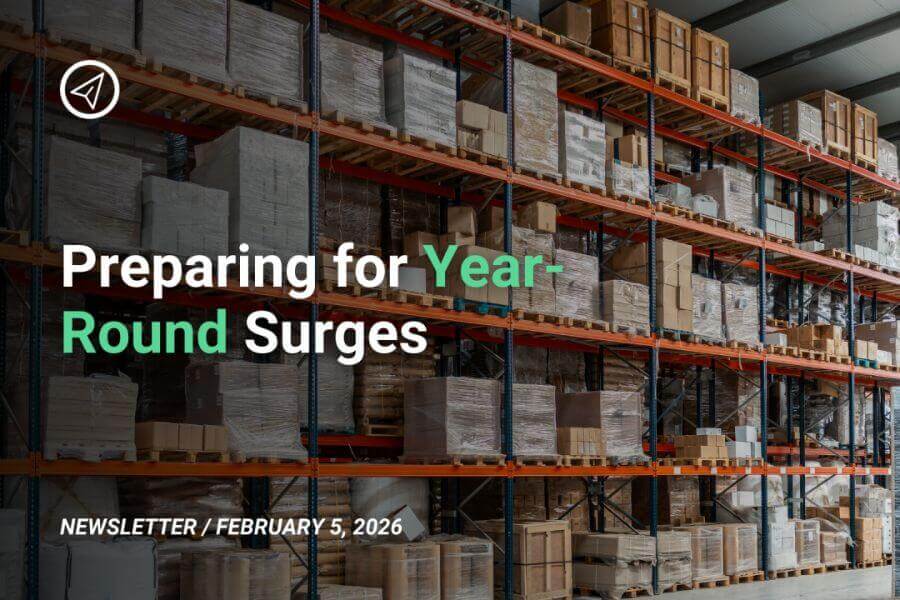
For years, peak season in logistics meant one thing: Q4. Black Friday, Cyber Monday, and the holidays dictated warehouse capacity, staffing, and shipping strategies. Businesses planned all year around a predictable spike that came and ended like clockwork.
That reality no longer exists.
It’s 2026, and supply chains of today face continuous demand surges driven by e-commerce growth, flash sales, influencer marketing, subscription models, and shifting consumer behavior. For many businesses, peak season now happens multiple times a year.
This new normal requires a fundamentally different approach to logistics planning.
Why Peak Season Has Become a Year-Round Challenge
Several forces have permanently changed demand patterns:
1. Ecommerce Has Trained Customers to Expect Speed—Always
Consumers no longer tolerate long fulfillment times outside the holidays. Same-day and next-day delivery expectations apply year-round, not just in December.
2. Promotions and Product Launches Drive Micro-Peaks
Flash sales, influencer drops, and viral moments can trigger sudden order spikes with little warning. These “micro-peaks” often rival traditional holiday volume.
3. Subscription and Replenishment Models Create Constant Volume
Recurring orders smooth revenue but increase operational pressure. Warehouses must perform at near-peak levels consistently.
4. Market Volatility Makes Demand Less Predictable
Inflation, shifting consumer spending, and global disruptions have made forecasting harder. Businesses must be prepared to scale quickly in either direction.
The result? Rigid logistics models break under constant pressure.
Why Traditional Fulfillment Models Fall Short
Many businesses still rely on strategies designed for a once-a-year peak:
- Fixed warehouse space
- Seasonal labor ramp-ups
- Manual processes
- Limited inventory visibility
These models struggle when demand spikes unexpectedly or repeatedly. The cost of over-preparing is high, but under-preparing leads to delayed shipments, lost customers, and damaged brand trust.
How Businesses Can Prepare for Continuous Peak Conditions
1. Build Flexibility Into Warehousing Strategy
Instead of locking into fixed capacity, businesses need access to scalable warehouse space that can expand or contract as demand changes.
A flexible warehousing model allows companies to:
- Handle sudden order surges without overcommitting year-round
- Avoid paying for unused space during slower periods
- Expand into new regions without heavy capital investment
This is where 3PLs provide a major advantage—offering shared infrastructure that adapts in real time.
2. Rethink Labor as a Variable, Not a Bottleneck
Labor shortages are one of the biggest constraints during peak periods. Relying on temporary hiring alone is risky and increasingly expensive.
Preparation strategies include:
- Leveraging warehouses with trained, scalable labor pools
- Using standardized processes that allow quick onboarding
- Implementing automation where it improves consistency and speed
Businesses that treat labor as a flexible resource—not a fixed cost—are far more resilient.
3. Improve Inventory Visibility and Forecasting
Year-round peak conditions require real-time insight, not quarterly planning.
Businesses should prioritize:
- Accurate, real-time inventory tracking
- Demand forecasting that incorporates promotions and campaigns
- Clear reorder points aligned with fulfillment capacity
Visibility across inventory and orders enables faster decisions when demand shifts unexpectedly.
4. Position Inventory Closer to Customers
Distributed inventory reduces risk during surges by:
- Shortening delivery times
- Lowering shipping costs
- Preventing bottlenecks at a single fulfillment center
A multi-node fulfillment strategy ensures that when volume spikes, orders can still flow efficiently.
5. Prepare Reverse Logistics for Peak-Level Returns
Returns don’t just spike in Q4 anymore. Promotions, apparel sales, and subscription models generate steady reverse logistics volume.
Businesses should ensure:
- Returns are processed quickly to recover inventory
- Systems can handle high inbound volume
- Returned products are routed efficiently back into stock or resale
Ignoring reverse logistics during peak planning is a costly mistake.
Why 3PLs Are Critical in a Year-Round Peak Environment
In today’s logistics landscape, 3PLs are no longer just overflow solutions—they’re strategic partners.
A strong 3PL relationship helps businesses:
- Scale fulfillment capacity without capital risk
- Access technology and expertise built for constant fluctuation
- Maintain service levels during unpredictable demand
- Focus internal teams on growth, not firefighting logistics issues
Instead of planning for one peak, businesses gain the ability to operate at peak performance continuously.
Peak Readiness Is the New Competitive Advantage
Year-round peak season is not a temporary trend. It’s the new operating reality. Businesses that invest in flexible fulfillment, scalable labor, and strong logistics partnerships will not only weather demand surges—they’ll turn them into growth opportunities.