If you run an ecommerce business, you already know that fulfillment can make or break your customer experience. Fast shipping, accurate orders, and smooth warehouse operations aren’t optional; they’re expected.
That’s where batch fulfillment comes in.
Batch fulfillment is one of the most effective strategies for scaling order processing without exploding your labor costs. Whether you’re shipping K-beauty subscription boxes, running flash sales, or managing global DTC logistics, this method can dramatically improve efficiency.
In this guide, we’ll break down everything you need to know about batch fulfillment, including how it works, why it matters, and when to use it.
What Is Batch Fulfillment?
Batch fulfillment is a warehouse strategy that groups multiple similar orders together into one “batch” for picking, packing, and shipping.
Instead of picking items for one order at a time, warehouse staff collect products for multiple orders in a single trip through the warehouse.
For example:
- 50 customers order the same sheet mask
- Instead of walking to that SKU 50 times, a picker grabs all 50 in one trip
- Orders are sorted and packed individually afterward
This method eliminates repetitive movement and dramatically reduces travel time inside the warehouse.
It’s especially powerful for:
- High-volume sellers
- Subscription box businesses
- Flash sales
- Promotional campaigns
- DTC beauty brands
How Batch Fulfillment Works
Batch fulfillment typically follows a structured process powered by a Warehouse Management System (WMS).
1. Order Grouping
Orders are grouped based on shared characteristics such as:
- Same SKU
- Same shipping method
- Same destination region
- Similar packaging requirements
Modern WMS software automatically identifies overlapping SKUs and builds optimized batches.
2. Optimized Picking Routes
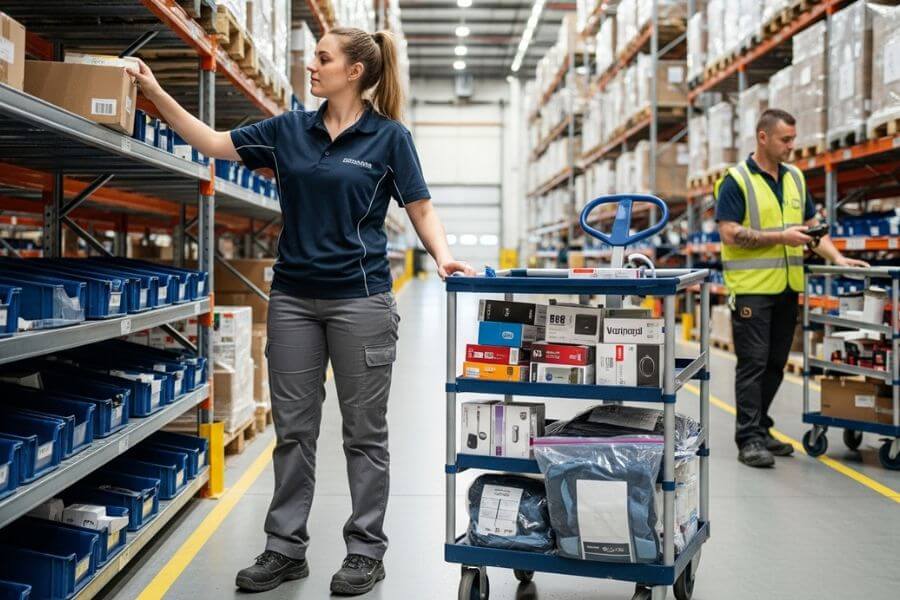
The WMS assigns the batch to a picker with a route that minimizes walking time.
Instead of zig-zagging across aisles for individual orders, pickers complete one efficient sweep through the warehouse.
This alone can reduce picker travel time by up to 50%.
3. Sorting at Batch Station
Once all items are collected, they’re brought to a sorting station.
Many fulfillment centers use:
- Put-to-light systems
- Barcode scanning
- Digital batch lists
These tools ensure items are distributed accurately into individual orders.
4. Packing & Shipping
After sorting, orders are packed individually and labeled for shipment.
From there, they enter the shipping workflow, whether domestic or global.
For international fulfillment hubs (such as logistics centers shipping from Busan to global markets), batch processing significantly accelerates outbound volume during peak demand.
Key Benefits of Batch Fulfillment
Increased Efficiency
Reducing travel time means pickers can process more orders per shift. Instead of wasting time walking back and forth, they stay productive.
Higher pick rates = faster order turnaround.
Lower Operational Costs
Batch fulfillment reduces:
- Labor hours per order
- Congestion in warehouse aisles
- Repetitive movement
- Picking errors
Fewer errors also mean fewer returns and customer complaints, saving even more money long term.
Improved Scalability
Batch fulfillment is ideal for handling:
- Holiday peaks
- Product launches
- Influencer promotions
- Flash sales
You can increase output without proportionally increasing staff.
Higher Accuracy
When teams focus on similar SKUs within a batch, the chance of mistakes decreases.
Combined with barcode scanning and put-to-light systems, batch fulfillment supports strong quality control.
Batch Picking vs Other Picking Methods
Understanding how batch fulfillment compares to other methods helps determine when it’s the best choice.
Batch Picking
- Groups multiple similar orders in one trip
- Best for high-volume operations with overlapping SKUs
Single-Order Picking
- One order at a time
- Best for custom or low-volume businesses
Wave Picking
- Orders released in scheduled waves
- Best for strict shipping deadlines
Zone Picking
- Pickers assigned to specific warehouse zones
- Best for large, diverse inventories
Batch picking excels when multiple customers are ordering the same products, common in beauty, skincare, and subscription commerce.
How to Implement Batch Fulfillment
If you’re considering adopting batch fulfillment, here’s how to start:
1. Analyze Your Order Data
Look for:
- Frequently ordered SKUs
- Repeating bundle combinations
- Regional shipping clusters
Data determines effective batching criteria.
2. Invest in a Strong WMS
Automation is critical. Your WMS should:
- Group orders dynamically
- Optimize picking routes
- Track performance metrics
- Integrate with your ecommerce platform
Platforms like Shopify integrate smoothly with modern WMS systems for real-time order syncing.
3. Train Warehouse Staff
Teams must understand:
- Batch list workflows
- Sorting procedures
- Quality control checks
Clear SOPs reduce confusion and errors.
4. Start with a Pilot Program
Test batch fulfillment during off-peak periods.
Start with batches of 10–20 orders to avoid overbatching and gradually scale up.
Ideal Use Cases for Batch Fulfillment
Batch fulfillment works best when:
- You sell identical or similar SKUs
- You run subscription services
- You manage bulk promotions
- You ship high volumes of standardized products
It’s especially powerful for:
- K-beauty brands shipping popular sheet masks
- DTC skincare brands
- Electronics accessories sellers
- Seasonal promotional campaigns
However, if your business specializes in highly customized products, batch fulfillment may need to be paired with hybrid strategies.
Is Batch Fulfillment Right for Your Business?
Batch fulfillment is one of the most efficient order processing strategies for growing ecommerce brands.
If your business handles:
- High SKU overlap
- Frequent product launches
- Promotional spikes
- Global shipping volume
Then batch fulfillment can dramatically increase productivity while keeping costs under control.
For brands scaling internationally or working with 3PL partners, batch fulfillment often becomes the backbone of efficient operations.
Conclusion
In today’s competitive ecommerce landscape, speed and accuracy aren’t luxuries; they’re survival tools.
Batch fulfillment helps businesses:
- Ship faster
- Reduce labor costs
- Improve accuracy
- Scale sustainably
If your warehouse is starting to feel chaotic during peak seasons, batching might be the operational upgrade you need.
The smarter your picking strategy, the stronger your logistics foundation becomes.